



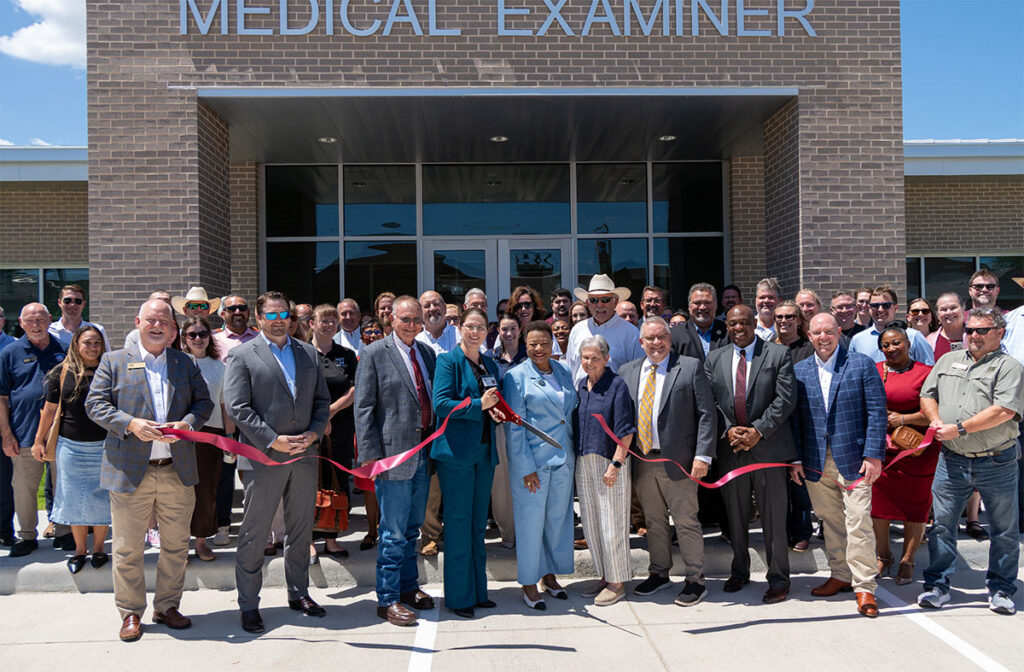
The Brazos County Medical Examiner’s Office officially opens on Oct. 1, 2026 and serves as the base for medicolegal investigation into deaths for the people of Brazos County.
We are committed to providing medical and scientific determinations of cause and manner of death for individuals dying as a result of violence, trauma, intoxication, sudden and unexpected natural disease, and unknown causes.
Contact Us
3037 E. 29th St.
Bryan, TX 77802
Phone: (979) 361-2630
Hours
Monday – Friday
8 a.m. – 5 p.m.
Funeral Home Pickups
Monday – Friday
Noon – 4 p.m.
(Please call ahead if the release needs to be expedited.)
Dr. Jennifer Dierksen
Director of Forensic Services
Email

What is a Medical Examiner?
A medical examiner is a physician with prior training and experience in pathology, toxicology, histology and other medicolegal sciences who has been appointed to conduct death investigations and perform postmortem examinations by a county.

What is an Autopsy?
An autopsy is the detailed external and internal examination of a decedent (deceased person) in order to determine cause and manner of death.
The external examination documents physical characteristics of the body, evidence of medical intervention, and signs of disease, injury and/or decomposition.
The internal examination involves the dissection of the body, including the removal and examination of the internal organs and brain to look for signs of disease (including microscopically) and injury.
An autopsy can typically take one to a few hours to perform, depending on the circumstances of the case, such as complexity of injuries. An autopsy may also include radiological imaging.
After an autopsy, the decedent can be released to the chosen funeral home shortly thereafter unless further steps are needed such as scientific identification.

What is a Forensic Pathologist?
A forensic pathologist is a physician who has been specifically trained in forensic pathology and in anatomic and/or clinical pathology in order to determine cause and manner of death, particularly in deaths concerning for non-natural causes. They perform autopsies, examine tissues using a microscope, collect evidence, identify deceased persons, review medical records, testify in court or other legal settings, and sometimes attend scene investigations.

When is a Death Investigation Conducted?
Per Article 49.25 of the Texas Code of Criminal Procedure, a medical examiner or justice of the peace is authorized to conduct a death investigation pertaining to deaths in the following categories:
- A person dies within 24 hours after admission to a hospital, institution, prison, or in jail
- Unattended deaths
- Where cause of death is unknown
- Deaths by unnatural causes
- Suspicious deaths
- Suicide
- Children younger than six years of age
Frequently Asked Questions
No. At the discretion of the medical examiner, a decedent may only need an external examination with a review of the medical records.
No. Any autopsy performed by the Medical Examiner’s Office is at the discretion of the medical examiner and is a service provided by the County.
Religious objections to autopsy will be considered by the medical examiner on a case-by-case basis.
No, we do not allow viewings at the Medical Examiner’s Office. However, a viewing may be allowed at the designated funeral home at the discretion of the funeral home.
Generally, a decedent may remain at the office 24 to 48 hours, or longer, depending on additional steps that may need to be performed such as scientific identification.
An autopsy report generally takes less than 60 to 90 days to complete, depending on the finalization of toxicology results or if further investigation or testing is needed.
Frequently, the final cause and manner of death may depend on the completion of a medicolegal investigation and/or the results of various postmortem examinations and review, such as toxicology results, microbiology results, review of histology, genetic testing, and review of the medical records.
As such, while the investigation and the completion of testing is ongoing, the cause and manner of death on the death certificate may be entered as “Pending,” which means pending further investigation.
When the investigation has been completed and the sum of the postmortem examination findings have been interpreted, the autopsy report can be completed and finalized, and the death certificate can be amended with the final cause and manner of death.
The signs of an autopsy can be hidden under clothing and by the arrangement of the hair and head pillow in the casket. There are some conditions (such as decomposition or significant injury) where having an open casket funeral may not be an option. This option is ultimately at the discretion of the funeral home.
Autopsy reports may be requested from the Medical Examiner’s Office. The legal next-of-kin can receive an electronic copy without cost.
According to the Texas Public Information Act, an autopsy report is public information and may be released to anyone who requests a copy unless there is an exception under the law.